The most sophisticated smart homes in 2026 aren't defined by the gadgets sitting on your counters, but by the high-performance cabling hidden deep behind your drywall. It's a common source of anxiety for Calgary homeowners; the fear that once the walls are closed, your new build is already technologically obsolete. You likely want the seamless convenience of professional automation without the clutter of visible hardware or the frustrating lag often found in DIY, Wi-Fi-only setups. We understand that you need a home that works perfectly from day one and remains functional as technology evolves.
This guide explores essential smart home wiring design ideas 2026 to help you build a robust, "limited energy" infrastructure that supports everything from immersive video walls to AI-driven climate control. You'll discover the specific cables required for a future-proof foundation, such as Cat6a and PoE++ standards, and learn where to position your head-end equipment for maximum aesthetic harmony. At Progressive Electronic Design, we provide the technical clarity you need to ensure your property remains at the cutting edge of luxury living through 2030 and beyond.
Key Takeaways
- Understand why a robust wired backbone is the secret to a reliable smart home, effectively solving the "Wireless Paradox" in modern Calgary estates.
- Explore essential smart home wiring design ideas 2025, including the transition to Cat6A and strategic fibre optic placements for long-term network stability.
- Learn how centralized lighting panels and specialized pre-wiring support human-centric lighting solutions like Ketra while maintaining a clean, minimalist aesthetic.
- Discover the necessary infrastructure for high-end entertainment, from invisible distributed audio to the significant bandwidth requirements of luxury video walls.
- Master the design of a professional "head-end" technical centre, focusing on thermal management and organized rack systems to ensure your equipment remains cool and accessible.
The Foundation of a 2025 Smart Home: Why Wires Still Win
The definition of a modern residence has changed. In 2025, we're seeing a decisive move away from fragmented, cloud-dependent gadgets toward integrated systems that prioritize local, wired reliability. While wireless convenience is enticing, a truly "smart" estate relies on a robust physical layer. Implementing professional Structured Cabling ensures that your home control systems, lighting, and security operate with the precision and speed that luxury living demands.
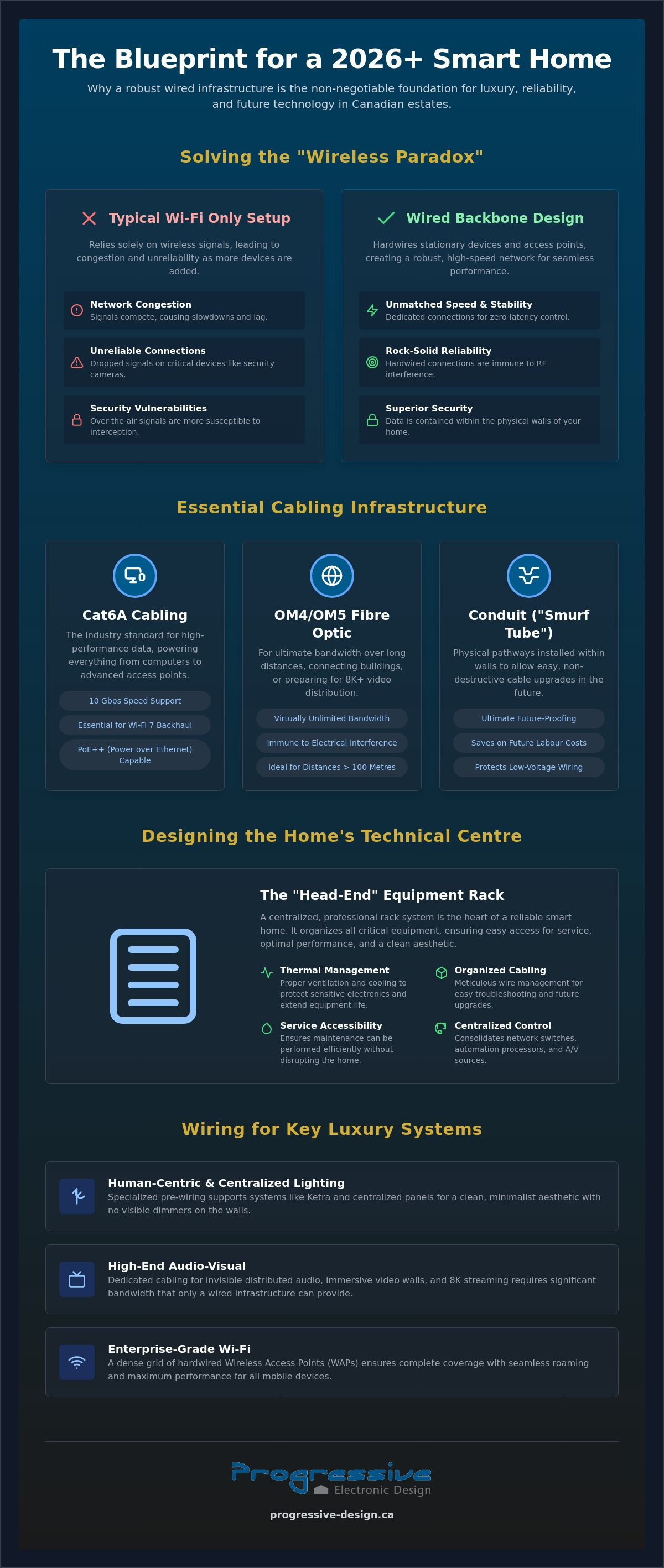
You might assume that the rise of wireless standards like Matter and Thread makes physical wires redundant. Paradoxically, the opposite is true. This "Wireless Paradox" means that as you add more battery-operated sensors and voice-controlled devices, the demand on your network infrastructure actually intensifies. These devices require a dense grid of hardwired wireless access points (WAPs) to maintain a stable mesh network. Without a wired backbone to handle the heavy lifting, your wireless ecosystem will inevitably suffer from dropped connections and sluggish response times.
When considering smart home wiring design ideas 2025, it's helpful to view these installations as long-term investments rather than mere construction costs. For Calgary luxury properties, professional pre-wiring significantly bolsters resale value. Sophisticated buyers recognize the difference between a house filled with DIY plugs and a home engineered for performance. They want the peace of mind that comes with a system designed by a meticulous expert who values order, efficiency, and technical excellence.
Reliability vs. Convenience: The Case for Hardwiring
Hardwiring eliminates the frustrating latency often found in lighting and security integrations. In tech-heavy neighbourhoods, radio frequency (RF) interference can disrupt wireless signals, causing "ghost" triggers or failed commands. By keeping high-bandwidth data on physical copper or fibre, you reduce airwave congestion. More importantly, hardwired connections offer superior security. Sensitive data remains within the physical confines of your walls; this makes it much harder for external parties to intercept compared to over-the-air transmissions.
The 2025 Tech Landscape: Wi-Fi 7 and Beyond
The arrival of Wi-Fi 7 has redefined our expectations for speed, but its potential is only realized with the right foundation. Wi-Fi 7 access points require 10Gbps-capable backhaul wiring to function at peak performance. If you're preparing for 8K streaming or immersive VR/AR experiences, a "Wired First" policy is essential. We recommend hardwiring every stationary device, including televisions, gaming consoles, and desktop computers. This strategy reserves your wireless bandwidth for truly mobile devices, ensuring a seamless experience for every occupant in the home.
Structured Cabling: The Essential 2025 Networking Backbone
Selecting the right physical media is the most critical decision in your infrastructure plan. While Cat7 often appears in marketing materials, Cat6A remains the industry standard for high-performance residential environments. It reliably supports 10Gbps speeds, which is essential for the Wi-Fi 7 backhaul we discussed previously. For distances exceeding 100 metres or for linking separate structures on a Calgary estate, pulling OM4 or OM5 fibre optic glass is a superior choice. This ensures your network remains immune to electromagnetic interference while providing virtually unlimited bandwidth for future upgrades.
Integrating conduit, often called "smurf tube," is one of the most effective smart home wiring design ideas 2025 can offer. It creates a physical pathway that allows for the easy replacement of cables as standards evolve. Instead of tearing into finished drywall in 2035, you simply pull new lines through the existing pipes. Adhering to national electrical codes during this phase ensures that your limited energy wiring is segregated correctly from high-voltage lines. This prevents signal degradation and maintains the highest safety standards for your family.
When planning your build, these smart home wiring design ideas 2025 provide a roadmap for a system that is both scalable and incredibly stable. A comprehensive system consultation can help you map out these details before the first wire is even pulled, ensuring your infrastructure is as organized as it is capable.
PoE: The Invisible Power Revolution
Power over Ethernet (PoE) has evolved into a powerhouse for modern automation. With PoE++ (802.3bt) delivering up to 90W, we can now power motorized window shades, security touchscreens, and even architectural lighting through a single data cable. This eliminates the need for bulky power supplies at every device location. Centralizing power in a rack room creates a cleaner aesthetic and allows for a single, robust battery backup to keep the entire system online during a power outage.
Structured Cabling Layouts
The most reliable designs utilize a "Star Topology," where every cable runs directly back to a central equipment closet. We always include generous service loops at both ends of the run; these extra coils of cable provide the flexibility needed for future maintenance or component swaps. Meticulous labelling and documentation are the hallmarks of a professional installation. This level of organization ensures that any future technician can understand the system layout instantly, saving you time and money on future service calls.
Innovative Wiring Ideas for Lighting and Climate Control
Lighting and climate control are the most immediate ways a homeowner interacts with their environment. In 2025, the trend is moving away from visible hardware toward integrated systems that disappear into the architecture. One of the most impactful smart home wiring design ideas 2025 is the shift toward centralized lighting panels. By moving the dimmers and switches to a remote equipment room, you eliminate "wall acne," the unsightly rows of switches that clutter modern interiors. Instead, a single, elegant keypad can control multiple scenes; this provides a minimalist aesthetic that highlights your home's design rather than its hardware.
This infrastructure is also essential for implementing human-centric lighting, such as Ketra. These systems require specialized wiring to deliver the data and power necessary to mimic the natural progression of sunlight throughout the day. This level of precision is impossible with standard electrical wiring. Similarly, motorized shading requires dedicated low-voltage lines to ensure silent, perfectly synchronized movement across a bank of windows. This creates a seamless transition between natural and artificial light that enhances both comfort and energy efficiency.
Architectural Lighting Control Design
Effective lighting design extends beyond the ceiling. We recommend pre-wiring for low-voltage accent strips in toe-kicks, under cabinets, and within wall niches. These subtle details add depth to a room and can be programmed for "pathway" lighting at night. By integrating motorized shades into the primary lighting control system, you can manage the entire luminous environment from a single interface. This coordination ensures that your shades close automatically when the sun is at its peak, protecting your furniture and maintaining the vibrant colours of your decor.
Smart Climate Infrastructure
Traditional climate control often relies on a single thermostat in a hallway, which rarely reflects the actual temperature of every room. A modern approach involves wiring for remote temperature and humidity sensors in every major living space. This allows the system to balance heating and cooling based on occupancy and sun exposure. In Calgary, where winter air is notoriously dry, integrating your humidifier into this wired network is vital. Proper sensor placement ensures that your HVAC system responds accurately to the specific needs of each zone, providing superior comfort while reducing energy waste.
Infrastructure for High-End Audio-Visual and Security
High-end entertainment and security are the most visible expressions of luxury, yet their success depends on what you pull through the studs during the rough-in phase. For Calgary estates, this often includes planning for basement developments and expansive outdoor living areas that require specialized connectivity. One of the most effective smart home wiring design ideas 2025 is to prioritize invisible distributed audio. By pre-wiring 14-gauge oxygen-free copper to every room, you can install architectural speakers that disappear into the ceiling; this provides high-fidelity sound without cluttering your floor plan with bulky cabinets.
The rise of the residential video wall represents a significant leap in bandwidth requirements. Unlike a standard television, a large-scale display might require multiple high-speed data feeds to maintain 8K resolution and synchronized refresh rates. Relying on wireless signals for these displays is a recipe for visual artifacts and lag. We pull multiple Cat6A lines to these locations to ensure a flawless visual experience. This wired foundation is the only way to guarantee the performance of the latest smart home wiring design ideas 2025, especially as video technology continues to evolve toward higher bitrates.
The Death of the Long HDMI Cable
HDMI cables are notorious for failing over distances greater than five metres. To avoid this, we utilize HDBaseT or Audio-Video over IP (AVoIP) technologies. These systems allow us to transmit uncompressed 4K or 8K signals over the same Cat6A wiring used for your home network. By centralizing media players like Apple TV or a Kaleidescape movie server in a dedicated rack, you keep the area around your displays clean and minimalist. We also pull extra lines for eARC (Enhanced Audio Return Channel), allowing your television to send high-resolution audio back to your central amplifier for a truly immersive experience.
Perimeter and Access Security
Security is an area where reliability is non-negotiable. Hardwiring motorized gates and access control points ensures an instant response when a guest arrives at your property line. While Wi-Fi cameras are common in the DIY market, professional security integration relies on Power over Ethernet (PoE). This provides a dedicated data path to a local Network Video Recorder (NVR), keeping your footage secure and off the public cloud. For Calgary homeowners, weather-proofed burial-grade cabling is essential for intercoms and perimeter sensors to withstand our extreme temperature fluctuations. If you're ready to secure your property with a professionally integrated solution, our team can help you design a custom security and AV plan tailored to your estate.
Future-Proofing Your Calgary Estate: The Progressive Design Approach
The final stage of implementing smart home wiring design ideas 2025 is establishing a centralized technical hub, often referred to as the "head-end" closet. This space serves as the brain of your Calgary estate; it houses the network switches, automation processors, and amplifiers that power your home's intelligence. Without a dedicated, organized centre, even the most expensive wiring infrastructure can become a maintenance nightmare. Heat is the silent killer of high-performance electronics. If components are left in a confined space without proper ventilation, their lifespan and performance will degrade rapidly.
We prioritize active cooling solutions and rack-mounted configurations that allow for optimal airflow. This meticulous approach ensures that your system remains stable during the hottest summer days and the most demanding usage periods. Professional documentation is the final piece of the puzzle. A comprehensive wiring map is your property's most valuable manual, allowing any future technician to understand the system layout instantly. This level of organization ensures that your home is ready for the technological advancements of 2030 without requiring further renovations.
Designing the Tech Closet
A professional tech closet utilizes standardized 19-inch rack-mounted systems for maximum efficiency. These racks provide a structured environment where components are easily accessible for service or upgrades. We implement dedicated power circuits with high-grade surge protection to shield your investment from Calgary's occasional power fluctuations. Meticulous cable management is not just about aesthetics. It ensures that every line is traceable and organized. By using patch panels and specialized labels rather than generic ties, we maintain the integrity of the high-speed Cat6A lines discussed earlier in this guide.
The Professional Consultation Advantage
Achieving a truly invisible and reliable smart home requires coordination that goes beyond traditional electrical work. An AV designer should collaborate with your architect and interior designer during the initial planning phases. This prevents common "electrician-only" mistakes, such as placing keypads in awkward locations or failing to account for the depth of motorized shade pockets. Expert guidance ensures that the smart home wiring design ideas 2025 you choose are scaled correctly for your specific lifestyle needs.
By following this structured approach, you transition from owning a collection of gadgets to possessing a sophisticated, integrated system. This foundation ensures your home remains at the pinnacle of luxury and functionality for years to come. Ready to plan your 2025 build? Book a professional system design consultation with Progressive Electronic Design to ensure your future-proof foundation is executed with precision and craftsmanship.
Elevating Your Home with a Permanent Digital Foundation
Designing a luxury estate in Calgary requires more than just high-end finishes; it demands a technical infrastructure that can support the next decade of innovation. By prioritizing a wired backbone and centralized equipment, you eliminate the unreliability of wireless congestion and the visual clutter of traditional hardware. These smart home wiring design ideas 2025 ensure that your property remains a high-performance environment where technology serves your lifestyle without compromise. A robust foundation is the difference between a house filled with gadgets and a truly integrated estate.
As Calgary’s leading experts in high-end automation, we specialize in Lutron lighting, Ketra integration, and bespoke AV systems that require meticulous planning. Our team provides the detailed documentation and craftsmanship necessary to turn a standard build into a sophisticated, future-proof home system. We invite you to Start Your Custom Smart Home Design Journey Today to see how professional integration can transform your living space. Your vision for a seamless, automated home is within reach, and we're here to guide you through every technical detail with precision and care.
Frequently Asked Questions
Why should I bother with wiring if Wi-Fi 7 is so fast?
Wi-Fi 7 is incredibly fast, but it still requires a wired backhaul to maintain peak performance across a large estate. Hardwiring stationary devices like 8K televisions and gaming consoles removes high-bandwidth traffic from the airwaves. This leaves your wireless network clear for truly mobile devices; this ensures that your automated shades and sensors respond instantly without interference or lag from heavy streaming.
What is the best type of ethernet cable to use in 2025?
Cat6a is the optimal choice for 2025 because it reliably supports 10Gbps data transfer speeds over distances up to 100 metres. While Cat8 is available, its limitations on distance and higher cost make it less practical for most residential applications. Cat6a provides the necessary bandwidth for Wi-Fi 7 access points and high-resolution video distribution while remaining fully compatible with standard networking hardware.
Where should I locate my smart home "brain" or tech closet?
You should locate your tech closet in a centrally positioned, climate-controlled area that is easily accessible for future maintenance. In many Calgary estates, a dedicated portion of the basement or a conditioned utility room is the preferred choice. This location must have adequate ventilation to dissipate the heat generated by amplifiers and processors; this ensures your system remains stable year-round.
Can I add smart home wiring to an existing home in Calgary?
You can absolutely add smart home wiring to an existing home in Calgary by using specialized retrofitting techniques. We often utilize attics, crawl spaces, and even decorative millwork to route new cables without damaging your finished walls. This approach allows you to integrate modern smart home wiring design ideas 2025 into a character home while maintaining its original architectural integrity and charm.
What is "Smurf Tube" and why do I need it for my renovation?
Smurf Tube is a flexible, non-metallic conduit used to create dedicated pathways within your walls for future technological upgrades. Installing this during a renovation is one of the most proactive smart home wiring design ideas 2025 because it allows you to pull new fibre optic or copper lines in the future. It effectively eliminates the need to cut into your drywall when standards change in 2030.
How much does it typically cost to pre-wire a new home for automation?
The investment for pre-wiring depends entirely on the scale of your property and the number of integrated systems you plan to install. While it is difficult to provide a generic figure, it is always more economical to pull wire during the construction phase than to retrofit later. We focus on creating a scalable infrastructure that adds measurable value and technical longevity to your Calgary luxury estate.
Should I wire for speakers even if I don’t plan to buy them yet?
Wiring for speakers during the construction phase is highly recommended even if you don't plan on an immediate purchase. The cost of running high-quality speaker wire while the studs are exposed is minimal compared to the complexity of a future installation. This preparation allows you to add architectural, in-ceiling audio at any time without the mess or expense of a secondary renovation project.
What is the difference between an electrician and a smart home integrator?
An electrician handles high-voltage power and basic electrical safety, while a smart home integrator specializes in low-voltage system design and complex device communication. Integrators ensure that your lighting, climate, and security systems work together as a single, cohesive unit. This specialized expertise is required to manage the sophisticated programming and network stability that modern luxury automation demands for a seamless user experience.